The shift toward on-device AI in 2026 — observations
A direction that has been getting easier to see lately, without any single dramatic event triggering it: a meaningful slice of AI workload is migrating from the cloud back onto the device. We are not making a prediction here — we are noting what we see in our own work and in the tools we evaluate.
The shift is uneven. Heavy training stays in data centers; nothing about that has changed. But inference for everyday tasks — speech recognition, transcription, on-the-fly translation, code suggestion, image cleanup, simple summarization — is increasingly running on the user's machine, especially on the macOS and Windows laptops that knowledge workers actually use.
Three quiet enablers are doing most of the work. First, the size of useful models has come down. Quantized inference, distillation, and architecture iteration mean a model that would have needed a server in 2023 can now run on a consumer laptop. Second, on-device acceleration has caught up. Apple Silicon, modern integrated GPUs, and dedicated NPUs in recent x86 platforms make local inference fast enough to feel like local inference. Third, there is a runtime layer — open-source frameworks for running compact models on commodity hardware — that did not exist at this maturity two years ago.
The result, from a tool builder's perspective, is that you can now choose where inference happens. That choice did not exist before. It used to be cloud or nothing.
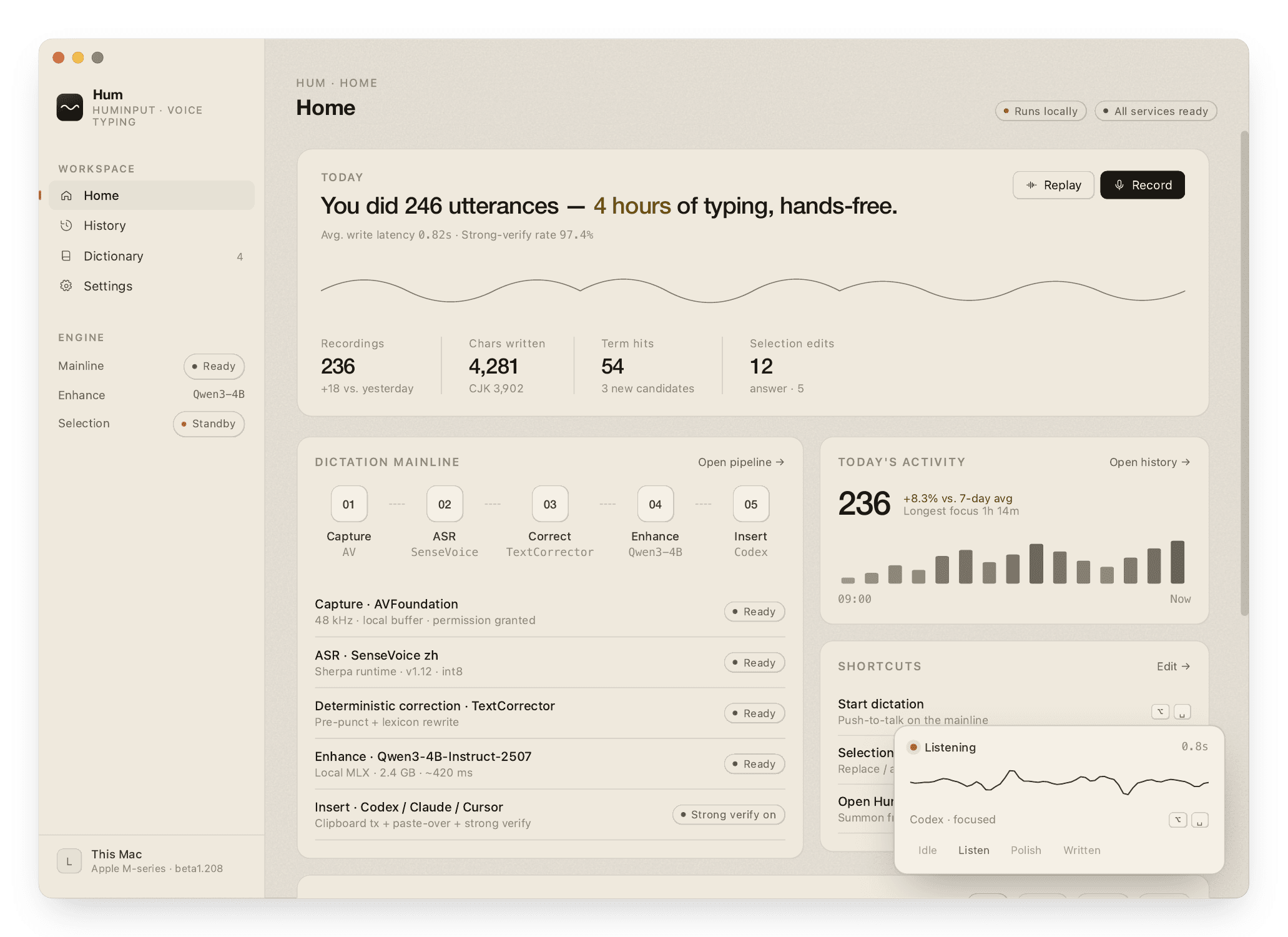
We see four implications worth flagging. The first is latency. Anything that runs locally avoids the round trip to a server, and for interactive use — voice typing, autocomplete, suggestion overlays — the felt difference between 80ms and 800ms is enormous. The second is privacy. Once the hot path is local, the question of what data leaves the machine becomes a product decision rather than a default. The third is reliability. Local inference works on a plane, in a tunnel, with bad Wi-Fi, in a corporate network with restricted egress. The fourth is cost structure: per-call API fees do not accumulate when there is no API call.
None of these are absolutes. Local inference today is still meaningfully behind the largest cloud models on the most demanding tasks. Some work genuinely needs the cloud. The right answer for most products is not "always local" or "always cloud" — it is a hybrid where the hot path is local and the heavy or infrequent path is remote.
The interesting design question is no longer "do we have AI in the product." It is: which capability has to be instant, which can wait two seconds, and which only needs to work occasionally. Each of those answers maps to a different runtime location. Products that get this mapping right will feel quick and stable. Products that put everything in the cloud will feel laggy and brittle. Products that put everything local will feel limited.
For our part, we have been operating from this assumption for a while. ORDO (formerly HUM) runs its core path locally. Our other tools follow the same pattern: keep the user-facing loop tight on the device, and only reach out to the network when the work clearly merits it. We expect this to be the default shape of desktop AI tooling for the next several years.